


What if I told you that LLMs—and most AI models—aren’t innovative?
That’s Bananas

Let’s start with an analogy of bananas.
Bananas growing on a tree are very much like novel inventions: Fascinating to look at, and potentially useful…but not immediately valuable.
The cost for someone to harvest one banana is small (picking it from the tree), and the benefits are similarly small (briefly sating hunger). If we define value as benefits over costs, “small over small” isn’t particularly valuable or innovative.
But if someone comes along and finds a way to harvest and distribute bananas for sale to customers in markets across the world—particularly markets where bananas don’t naturally grow—the bananas become quite valuable.
Delivery is central to innovative value creation: The same banana that’s worth $0.50 in a market can be worth $6,000,000 when taped to a gallery wall.
Innovation isn’t the banana itself. It’s in who you deliver it to, and how.
Inventions Aren’t Innovations
Innovation is the delivery of a novel solution to a customer, which creates value by providing benefits in excess of costs, in a way that’s superior to alternatives.
Inventions are often conflated with innovations. Most innovations involve an invention, but few inventions are by themselves an innovation.
Here are some examples of inventions and the innovations they led to:
Touchscreens were invented in the 1960s, but only became innovative when packaged up and delivered as part of the first iPhone in 2007.
The computer mouse was invented in the 1960s, too—but wasn’t innovative until it enabled Apple’s (then revolutionary) graphical user interface for the Macintosh in 1984.
Most recently, the transformer architecture (the foundation of most large-language models today) was published in Google’s now-famous 2017 paper, “Attention Is All You Need.”
While transformers enabled spectacular progress in AI research, they weren’t widely recognized as an innovation.
Not until ChatGPT packaged up a transformer model—the Generative Pre-trained Transformer (GPT) 3.5—in an accessible, web-based chat interface that enabled users across the world to ask the AI questions.
Today, I’d be hard-pressed to pick a bigger innovation of the 2020s than ChatGPT.
Now for the practical bit: How can you create valuable innovations of your own?
The NABC Framework for Value Creation
In 1998, the Stanford Research Institute (SRI) was on the verge of bankruptcy.
Over the next 16 years, SRI tripled in size, creating a range of innovations like Siri and the da Vinci Surgical System. What happened?
When Curtis Carlson joined SRI as its CEO in 1998, he drove a cultural transformation for the company.
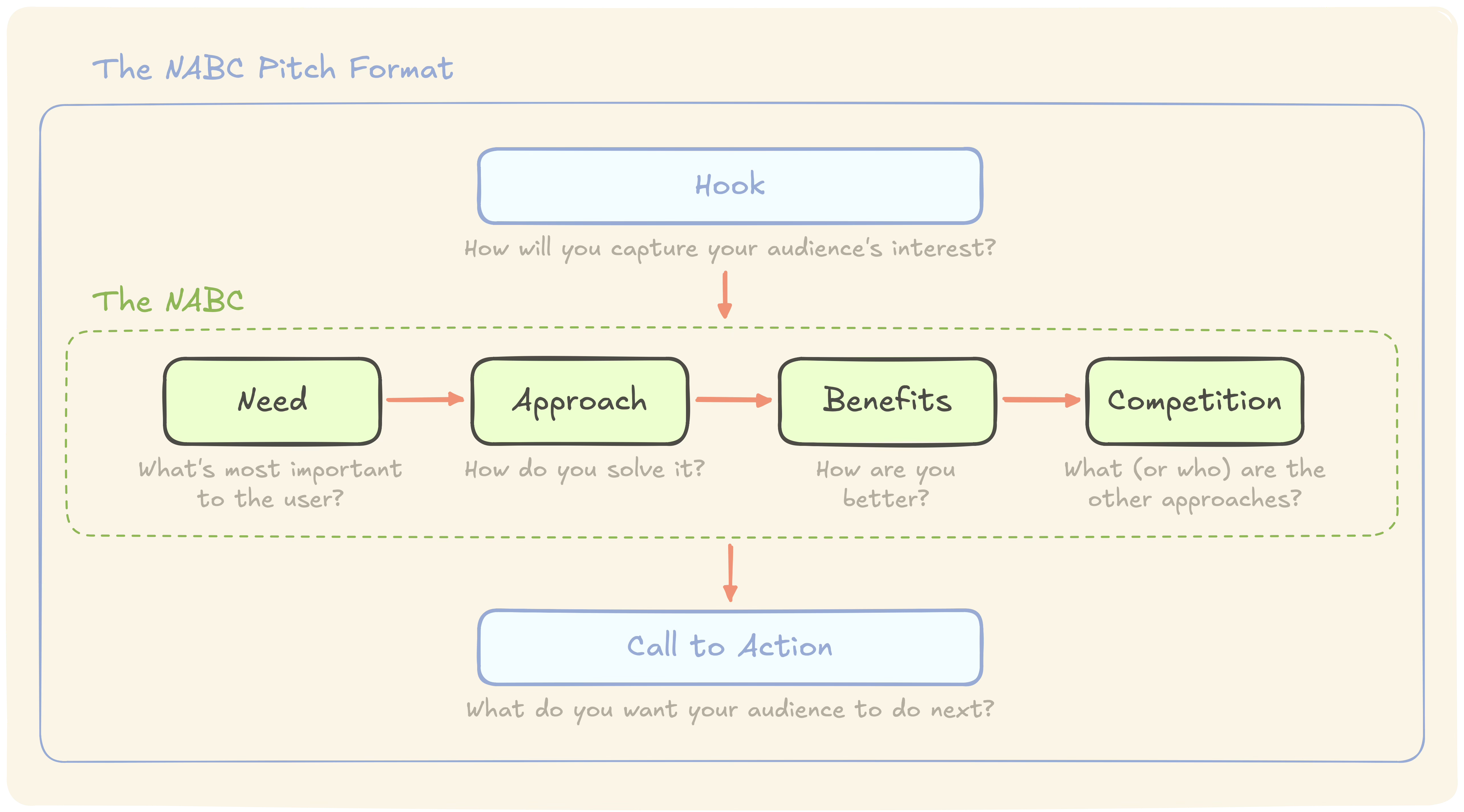
This transformation was driven by the NABC framework, which tasks inventors with answering four questions:
Need: What’s the most important thing to the user and the market?
Approach: What’s your unique approach, and your key insight into the need?
Benefits: What is the value to the user, in terms of the benefits over the costs?
Competition: How does the value differ from alternative approaches?
These answers are combined with an attention-grabbing hook and a call-to-action to form a complete NABC Pitch, tailored to a specific stakeholder.
Using the NABC Framework
I’ve the rare privilege of calling Curt my mentor. For more than two years as part of my innovation fellowship at Worcester Polytechnic Institute, Curt met with me (and multiple other founding teams) weekly to drill us on our NABC pitches.
To give you an idea of what this framework can produce (with enough iteration), here’s a subset of actual slides from the last deck I created and pitched with Curt:


My personal studio acquired Alicorn (the subject of the deck) in 2025—the Alicorn platform is now called Codas, which you can try at codas.dev.
To me, the most important part of an NABC pitch is the key insight: The idea that connects the need and the approach.
In the example pitch above, our key insight was twofold:
Most engineering work is “plumbing” data between formats and systems.
Most API failures happen because of this plumbing, and the rest happen because of centralized cloud outages.
We realized a decentralized platform with a unified data model could solve both problems simultaneously, and thus Alicorn was born.
Unfortunately, Alicorn struggled to become innovative: We had no delivery mechanism apart from open source, which is notoriously tricky to commercialize—though that trickiness is a subject for a future article.
Wrap-Up
So, are LLMs innovative? I argue no. The real innovation is in the products that package them and deliver them to customers in ways nothing else can.
What invention have you been treating as the destination, when it’s actually the start of your journey towards an innovative product?
Acknowledgements
Curt Carlson, for graciously reviewing the final draft of this article, and reminding me that value is defined as Benefits / Costs.
During my editing process, I used Anthropic's Claude Opus 4.7 to review my drafts for grammatical errors, and to give feedback on the structure and accuracy of my claims. AI was not used to generate any text.
During my editing process, I used OpenAI’s GPT 5.5 Pro to generate the composited lead image of bananas.
Yes I agree with open source being challenging to commercialize. It's the same in my experience: When I was at Salesforce we open sourced our monitoring application, and I found there was no budget to promote it, and our team was not interested in offering professional services either, since our main goal was servicing internal users.
Thanks for sharing the NABC framework, and yes I agree invention != innovation.